Are you having trouble with your office chair tilt lock? A broken tilt lock can disrupt productivity and comfort, making fixing the problem as soon as possible necessary.
In this guide, we will explore why the office chair tilt lock is not working and provide step-by-step instructions on how to fix it quickly.
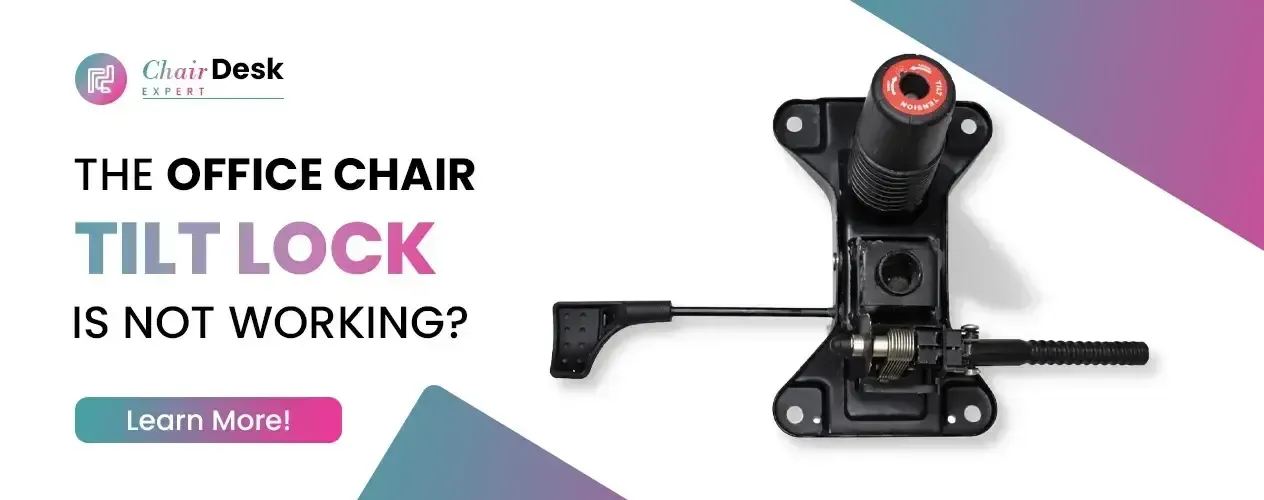
We will take you through troubleshooting for a faulty tilt tension knob, recliner knob, or office chair lever not working
Why is the office chair tilt lock not working on My Chair?
If your office chair tilt lock is not working there are problems with the locking mechanism of your office chair: It could be one of two things if I faced any issues arising from my seat’s recline function.
This usually happens when there are problems with the tension adjustment mechanism. The chair will be unable to lean back correctly because the tension knob has failed or is set too high.
When the person leans back in his/her chair, they must make an extra effort due to the excessive tension placed on it, which makes it impossible.
Again, a defective lever or spring could lead to tilting tensions. It becomes difficult for someone to adjust their position after sitting down since they cannot maintain a specific position once fixed, and then they start sliding again.
Replacing either the lever lock or spring in such instances might bring back its functionality. Identifying and resolving these issues helps solve your office chair’s tilting problems by ensuring optimal functionality.
Identifying the Problem
First, identify why The office chair tilt lock is not working.
Reviewing Office Chair’s Instruction Manual
Find where you put your instruction manual for this particular office chair. Consultation of this guide allows you to comprehend better how these chairs are made so that no more harm occurs during repair processes.
Test the Recline Functionality
Try leaning backward while sitting on your office chair’s backrest. Notice anything unusual about its movement? Depending upon what you find out, there may be various possibilities: Difficulty locking chairs’ recline position may show a problem with the lever mechanism.
When the spring is damaged, there is no tension in opening the lock, which you can notice by hearing the “pop” sound. The inability to move my chair at all could mean that its tension knob has been destroyed. Once you have identified what caused it, you can fix it.
Possible Solutions for Tilt Lock Mechanism
After identifying your problem, try these solutions to resolve the issue.
Adjusting Tension Knob
Excessively tight settings of this knob usually result in hindrance to your seat’s movement. To fix this concern, simply turn it anti-clockwise until a desired tension level is achieved. Avoid over-tightening it; too much weight applied to this mechanism could lead to further damage.
Repair or Replace Lever
You could be forced to repair it. Start by unbolting the bolts and removing the seat from the mechanism so that you can reach the lever.
If it has any cracks or damage, replace it entirely. If the lever has just popped out from its socket, use a screwdriver to return it to position. Lubricate all parts before putting them back together again.
Change Spring
Also, can a damaged spring cause problems with your recline system? Take your chair apart to get to the recliner spring. To fix a defective spring causing a tilt-back office chair not working correctly….
Office Chair Tilt Lock Repair: Changes or Replacements
Check for signs of damage, like dents or cracks on the tilt lock. If it is broken, you need to replace it; however, if it is loose, use a screwdriver to tighten it.
To access the tilt mechanism of the seat, the chair has to be turned over and the bolts removed to separate the seat.
Use some lubricant for easy release or detachment, then strike the base using a rubber mallet to dislodge it. Take away the cylinder by using a pipe wrench and inspecting each lever to identify the one that is broken.
Replacing the Tilt Mechanism
When the cylinder is taken out, the tilt mechanism becomes obvious. Using a screwdriver, remove the lock and replace it with a new one. Ensure that the tension knob faces forward before you tighten the screws tightly.
Reassembling the Chair
Put the cylinder in the center of the base and align the upper half of the chair with the cylinder; put pressure on them to let them be locked together mostly by sitting on a chair.
Test the recline function to ensure it was installed correctly; otherwise, seek help from a professional if necessary.
How to Lock Your Office Chair in an Upright Position
If you want stability and comfort during work hours, be sure your office chair is locked in the upright seated position, but it depends on your chair’s mechanism. Here’s a breakdown based on the number and location of levers under the seat:
Single Lever (Right Side)
For one-lever chairs, pull this lever towards yourself, keeping it locked in that position; otherwise, when pushed forward, the seat back will incline.
Two Levers (Right & Left)
These chairs have two levers: one to push down the left side, one to lock up the right side, and one to stand straight. They are called knee-tilt multi-lock chairs.
Two Levers (Both on the Right)
Finally, when you have chairs with two levers only on the right side, then use one further back, after which such action may provide a locking effect. A typical example is permanent-contact backrest chairs (PCB).
Three Levers (Two on the Right, One on the Left)
With three levers within PCBs, the lock rearward lever is located on the right-hand side, yet the frontward lever on the left hand can let the seat away from the backrest—independent seat and back tilt chair (ISB).
Three Levers (All on Right)
On heavy-duty ISB chairs, three levers are located on the right. The rearmost locks and unlocks the backrest, while the middle one serves the same purpose but is related to a seat tilt. The front lever moves the seat up or down.
However, if the latch does not hold, it may indicate a defective mechanism. You can replace this part without replacing the whole chair. Find office chair components suppliers online or ask for professional help.
How to fix an office chair not leaning back
When leaning back on your office chair does not appear to be a smooth process, or if a ‘pop’ is heard, one can perform the following to find out the problem and correct it:
Examine The Mechanism. Try Releasing Tension: It can be helpful to try one of the tension knob/pulling levers. The problem might be in the gas cylinder or other component parts if I don’t recline.
Have you tried turning the office chair upside down to check for issues?
Positioning: Turn the office chair upside down so that the casters point vertically upwards. You can do this by leaning against a wall or placing it on another chair for support.
This Would Require Removing the Gas Cylinder Clip.
The thin metallic clip that keeps the gas cylinder intact with the chair has to be removed; use pliers to hold it carefully and pull it off.
Washer and Nut:
Remove the washer and nut after removing the clip. You can also use pliers for this step.
Remove the Casters and Assembly Support Remove the Casters: Remove the star-shaped caster support from the chair base. It should have come off without a struggle.
Access the Bearings and Rings
Remove the Bearings and the Rings: You will see the bearings and the rings supporting the underside of the cylinder. Remove them carefully to allow yourself access to the gas cylinder.
Clean the Cylinder
Wipe Down:
Grab a paper towel and clean the cylinder by removing any remaining oil or debris. If the residue is very stubborn, you can use a degreaser.
Apply Lubricant
Lubricate the Cylinder: When the cylinder is cleaned, high-quality lubrication can be inserted, ensuring that the internal surface is coated throughout.
Reassemble the Components
Reattach Bearings and the Rings: Restore the bearings and the washers, the rings in their original position. Make sure these are all lubricated if required.
Reattach the Caster Base:
Return the caster base to the attached cylinder portion.
Overlay the Washer
Slide Washer into Place:
Push the washer into place on the cylinder once the caster base is secured.
Reattach the Retainer Clip
Final Step:
Lastly, the retention clip will be inserted to retain the gas cylinder in its position.
Additional Tips
Popping Sound: The gas cylinder might need further attention if you still hear the popping sound even after lubricating the mechanism. Regular Maintenance: Lubricate the mechanism occasionally so your chair can operate appropriately.
Professional Assistance: If the problem persists after these steps, it may be advisable to employ the services of a trained professional or contact the manufacturer’s customer support
Conclusion
After reading this article you can resolve the issue of my office chair tilt lock is not working. Repairing an office chair with a broken tilt lock enhances productivity and comfort.
For proper functionality at the workplace, regular maintenance must be done that includes tension adjustment, tightening of screws or parts replacements. If repair is not feasible, replacement should be done promptly for consistent ergonomic support.
FAQs!
1-How does a chair tilt mechanism work?
These mechanisms make the tilting action or rocking motion of office chairs possible. These usually are controlled by a giant circular knob or lever on the bottom side of your seat, and this lever will change either up or down from what is happening; for example, adding more force is required when someone leans back, allowing shoulders to come forward during working hours.
2-What are tilt controls on a chair?
Tilt control, also known as the “tension” feature, refers to a twisting knob that assists users in changing how much pressure they exert while reclining themselves into chairs with backs that bend all way according to individual taste; besides, this enables an individual tailoring their own perfect backrest’s angle so as not being strain too much when they’re working.
3-What is a tilt lock feature?
Ergonomic chairs possess an important characteristic called tilt lock. It lets users adjust the stiffness of their backrests by locking them into place through a simple mechanism (usually controlled by levers or knobs) at desired settings.
4-Should I lock my office chair?
Ideally, it is not good for you to fix your seat in one position. Instead, make sure that there is neither pressure nor a feeling of sinking as you lean back. So that as you type, talk on the phone, or recline, the chair’s back will move freely with one’s body movements.
5- Why did my office chair stop leaning back?
There could be several reasons why this happened. The problem may be a stuck tilt mechanism or a dry gas cylinder. If your office chair uses manual recline mechanisms, self-fixing might be possible.