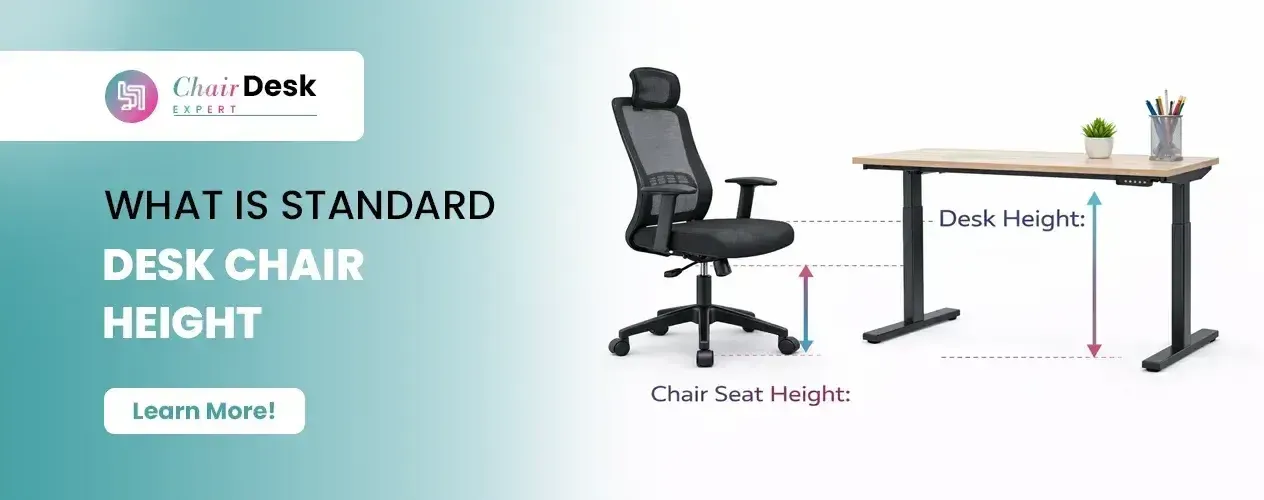
How high should my office chair be for comfort?” is a question people frequently ask. That’s not an easy question because it depends on your Height and what you do at work.
When selecting a desk chair, height is crucial for comfort and ergonomics. Most desk chairs are height adjustable, so users can attain a comfortable working height no matter their size or how they sit at the desk.
Whereas some chairs are adjustable from as low as 14.5 inches to as high as 21 inches, the standard chair height ranges from 16 to 21 inches.
A thorough understanding of these figures will ensure you choose the ideal chair that supports proper ergonomics and the individual’s comfort when seated for long periods.
Everyone is different, so the typical chair Height, desk, and computer screen can vary. Therefore, finding the Height that suits you best is essential so you will feel good and work productively.
What is Standard Chair Height? Explained
Knowing the basics matters if ergonomic comfort is to be achieved. In general, office chairs have a standard height of between 16 and 21 inches from the floor to the seat.
This gauging accommodates average leg lengths and permits feet-to-ground linkages while aligning cuffs with desks’ heights.
Nonetheless, individual body shapes and table pitches differ considerably, necessitating more personalized approaches to setting seat heights.
Is there a universal ideal desk chair height
An ideal office chair reduces the harmful consequences of prolonged sitting on the thighs, shoulders, neck, and arms; there is no perfect seat fitting or height.
The seat’s height should not be fixed; it should be modified according to individual body types and preferences. The best way to do this is to use desk proportionality to define the height of one’s chair.
Therefore, one’s forearms should be at the level of contour of the desk in this ideal.
In this case, one’s elbow geometry should be an angle of about 90 to 110 degrees while resting feet flat on the ground with one’s knees bent at 90 degrees.
Generally speaking, seat height within the range of 19 to 21 inches off the ground would be efficient for a few users, but having an adjustable chair height makes the case more preferred to every end user.
Key Office Chair Dimensions to Consider
Choosing the correct office chair is not only about choosing the desired style or color but also about understanding the dimensions to promote comfort, focus, and optimal ergonomics. Whether purchasing a chair for a small computer table setup or a big executive office setting, understanding the standard dimensions will help you make the right choice.
Seat Height
The average seat height from the floor to the top of the office chair is 16 to 21 inches. This range is adopted so that most desks and users can be seated comfortably at the desk in an ideal position.
Seat Width and Depth
Seat Width: The width of the typical seat is equal to that of the standard seat, i.e., it ranges between 17 and 20 inches depending on the gender of the users. Thus, there are still standard seating widths, which poses no risk in using too wide seating arrangements. Most desktop ports are not too wide to warrant ushenjerwa, so no one is weaker.
Seat Depth: Seating space should be available so that users can sit with their backs on the backrest. In this case, a gap of about 2 to 4 inches should remain between the back of your knees and the front edge of the seat. Seat depths range between 16 and 18 inches.
Backrest Dimensions
Height: The heights of the backrests vary. Middle-back chairs usually have bands of 12 to 22 inches, whereas high-back chairs offer more elevation from 22 to 32 inches.
Width: Generally, the backrest width ought to be equal to or less than the seat width, which measures between 17 inches and 20 inches, to provide adequate support to the entire back area.
Armrest Height and Width
Armrest Height: In most cases, when collapsible armrests are provided, a height of seven to ten inches is especially important since such a height aids the person seated in relaxation and prevents the shoulder from straining.
Armrest Width: The spacing between the armrests should be mobile about individuals’ bodies. Commonly, the distance falls between 18 and 22 inches apart.
Standard Office Chair Dimensions
For Smaller People
Chairs for small individuals attempt to achieve a better fit than regular chairs, which can tend to be oversized and dominate the user.
Seat Height: Approximately 15-17 inches.
Seat Weight: 17-19 inches.
Seat Depth: A seat depth of around 15-17 inches.
Backrest Height: 12-14 inches.
Up until this point, petite users have trouble keeping their lower bodies in a chair and, I guess, have avoided them since the regular office chairs appear to be large or too high even for many of them. Most manufacturers of these chairs provide lumbar support to improve posture.
Targeting Individuals of Average Build
The average-sized users would find replacement office chairs with several adjustable components on the market.
Seat Width: 17-20 inches
Seat Depth: 15-18 inches
Seat Height: 16-20 inches
Backrest Height: 15-20 inches
Armrest Height: 7-9 inches up from the seat
In other words, proper ergonomics is maintained for medium-sized individuals in terms of support offered; there are no areas that are too little and no areas that are excessively wide.
Targeting Heavier Users
Plus-size office chairs, known as the ‘big and tall’ category, are cheaper subcategories with larger capacities ranging from 300 to 500 lbs.
Seat Height: 17-21 inches
Seat Width: 21-24 inches
Seat Depth: 18-22 inches
Backrest Height: 16-18 inches
Armrest Height: Varies, generally 9-11 inches above the seat
Such chairs are usually equipped with lumbar support and come in different designs, like gaming chairs and mesh office chairs, to accommodate weighty users.
Choosing the Best Office Chair Height
Depending on your Height, a lead chart will help you choose the best office chair according to your height.
Your Height (feet)
Ideal Chair Height (inches)
Your Height (cm)
Ideal Chair Height (cm)
4’11”
15.9 inches
149 cm
40.2 cm
5’0″
16.2 inches
151.5 cm
40.9 cm
5’1″
16.4 inches
154 cm
41.5 cm
5’2″
16.7 inches
156.5 cm
42.2 cm
5’3″
17 inches
159 cm
42.9 cm
5’4″
17.2 inches
161.5 cm
43.6 cm
5’5″
17.5 inches
164 cm
44.2 cm
5’6″
17.8 inches
166.5 cm
44.9 cm
5’7″
18 inches
169 cm
45.6 cm
5’8″
18.3 inches
171.5 cm
46.3 cm
5’9″
18.6 inches
174 cm
46.9 cm
5’10”
18.9 inches
176.5 cm
47.6 cm
5’11”
19.1 inches
179 cm
48.3 cm
6’0″
19.4 inches
181.5 cm
49 cm
6’1″
19.7 inches
184 cm
49.6 cm
6’2″
19.9 inches
186.5 cm
50.3 cm
6’3″
20.2 inches
189 cm
51 cm
6’4″
20.5 inches
191.5 cm
51.7 cm
6’5″
20.7 inches
194 cm
52.3 cm
6’6″
21 inches
196.5 cm
53 cm
6’7″
21.3 inches
199 cm
53.7 cm
6’8″
21.6 inches
201.5 cm
54.4 cm
Factors to consider for Optimal Chair Height
Unlocking the secrets to achieving the perfect chair height involves considering various factors contributing to ergonomic comfort.
By carefully evaluating these elements, you can ensure an optimal seating position that promotes productivity and minimizes discomfort.
1-Keeping Forearms Parallel to Your Desk
In ergonomic terms, your chair should be of the right Height, making your forearms come out parallel to your desk surface and having an angle of 90 degrees at the elbow joints.
This arrangement is important for minimizing strain in the shoulder and neck areas, particularly for those who spend a lot of time working at their workstations. By doing this, you will significantly reduce the possibility of developing musculoskeletal problems.
Seat Inclination:
Usually, when discussing ergonomics in chairs, we tend to value chair height more than anything else, forgetting that seat tilt is also very important.
Slightly tilting the front part of your seat can help align your back naturally and alleviate pressure on your lower back, reducing discomfort and pain.
Lower Back Support:
Maintaining adequate lumbar support is critical for achieving an ideal chair height. Lumbar problems are common among office workers, meaning there needs to be coordination between the chair’s Height and backrest to maintain the standard curve of a person’s spine.
This support contributes towards long-term comfort as well as the general health of one’s backbone.
The Perfect Eye-Level View
The consideration concerning chair heights extends beyond physical alignment alone because it profoundly impacts our visual interaction with tasks.
One way to ensure that your eyes land comfortably at approximately one-third of the length from the top of the screen is by setting up a computer chair whose tilt allows sitting without unnecessary nodding, thus avoiding stress in both parts mentioned above.
The quest for the perfect office chair height calls for attention to people’s preferences regarding comfort and ergonomic principles.
While standards offer a starting point, everyone’s “ideal” depends on individual factors such as body size or habits at work, so taking foot placements into account alongside forearm alignment or seat inclinations plus what eye levels are concerned invariably leads to overarching wellness in workplaces.
Accessories to Enhance Your Office Chair Setup
Elevate your office chair setup with these essential accessories to enhance comfort and productivity. From ergonomic add-ons to customizable features, these accessories offer practical solutions for optimizing your workspace.
1-Height-Adjustable Desks:
These desks enable you to alter their heights, hence reducing prolonged sitting and its negative effect on health. They include a keyboard and monitor adjustment feature.
2-Keyboard Tray:
A tray for your keyboard ensures easy access without needing to adjust your chair or desk height.
3-Monitor Arm:
This attachment allows flexible adjustments for your monitor, maintaining an optimal viewing angle and contributing to proper chair height alignment.
4-Footrest:
Throughout the day, a footrest can help ease any stress and bridge the difference in Height between your chair and desk.
Tips and Tricks for a Good Fit
Adjusting one’s office chair is sometimes not enough to find the right fit around the chair. You should set aside some money over and above this for a new ergonomic chair if the current one does not serve this purpose well. Here are some tips and tricks that can help you deal with the issues of chair height, fit and ergonomics:
Seat Too High:
When this is the case, I recommend that a footresting device be employed if the seat is height adjustable; otherwise, look for a seat that can be lowered to the ground.
Seat Too Low:
If the seat is too low and the chair’s height does not reach the lower part of your kneecap area, a seat cushion can help temporarily solve the problem.
Seat Too Deep:
If the seat is too deep, the edge can cut into the backs of the knees. Consider adding a thick backrest cushion. This will bring the backrest nearer to the user chairs, adding comfort until replacement becomes possible.
Armrest Discomfort:
Armrests on chairs that don’t fit well or are located dangerously can worsen conditions like carpal tunnel syndrome. You can buy gel pads for them, remove the arm panel, or purchase a better-armed ergonomic chair.
Uneven Weight Distribution:
The seat tilt should be adjusted if the cushion height appears comfortable, yet the weight is not evenly distributed on the surface.
Wrong Desk Height:
First, ensure the desk has a minimum arm span at an ergonomic height while sitting and standing. Most adjustable desks go up and down and should be able to save the height setting that was last used.
Wrong Screen Height:
The ultimate goal of having a computer is to use it, and the screen should be at eye level. Of course, this may be affected by the adjustment of the chair. A monitor mount will help a lot in support of this.
Wrapping Up
Now you know about What is standard desk chair height is for you. Getting the right Height for your chair is essential for ergonomic comfort.
Prolonged periods of sitting can cause discomfort or health problems; thus, it is important to invest in adjustable seats that align with workers’ body components, ensuring proper posture when seated.
While there is no universal standard for desk chair height, most chairs fall between 16 and 20 inches. However, individual preferences and ergonomic needs may vary, so choosing a chair height that promotes comfort and proper posture for your specific requirements is essential.
Consider seat height, width, and depth to ensure an optimal seating experience that supports your overall well-being in the workspace.
FAQs Section: What is standard desk chair height?
1 What are the dimensions of a standard office chair?
Seat heights usually range from 16 – 20 inches (40.6 cm – 50.8 cm), while depths should be at least 18 inches (45.7 cm).
2-What size does a desk chair need to be?
Finding the Suitable Office Chair Dimensions (Step by Step)
However, most chairs don’t have specific standards for office chair dimensions, but within these office chair sizes:
Chair height should be between 16-20 inches.
Chair width should fall into the range of 19-21 inches.
Chair depth may vary from 15-19 inches.
3-What is a comfortable seat height?
For shorter people, seat height from 15″h to 17″h would be ideal.
The most comfortable seat height for taller persons is between 18 and 20″ h.
For shorter persons or those who enjoy sitting upright, seat depth should be between 21″d and 23″d.
For taller individuals or those who like sitting relaxed, seat depths should range between 23″-d and 25″-d.
4-What is standard office desk height
Most office desks have an average height of twenty-eight to thirty inches. This height is very common in offices around the globe and is adjustable for most individuals.
5-How do you measure chair height?
To measure chair height correctly, one must establish the distance between the floor (or footplate) and the highest point of the chair. The aim here is to ensure that the angle of knee to hip is as close to ninety degrees as possible with feet flat on the ground.
6-How do you measure office chair seat height?
The Height of an office chair is measured from its seating surface down to where it hits the ground (or footplate).
In order to get accurate measurements, begin behind the knee area and go all the way down until under the heel while seated.
This measure is essential because up to nineteen percent of someone’s body mass rests through their lower limb when they sit down.
7-What is the best chair height in CM?
The recommended chair height for an ergonomic office setup is between 35 to 40.5 centimeters (cm). This ensures that your thighs and feet are parallel to the floor, with your thighs and lower legs forming a 90 to 110-degree angle. Maintaining this position promotes proper posture and reduces strain on your lower body while seated.
Latest Articles
Expert reviews, guides, and insights for your perfect setup